For a recent production presented by members of the Department of Theatre at Michigan State University, the audience became part of the performance, one that transformed a healthcare simulation center into a deeply intimate, immersive theatrical experience that blurred the line between actors and audience.
The Department of Theatre production of “Mary Jane” was not confined to the stage, nor was the audience confined to their seats. As the performance moved through hallways, an apartment, exam and hospital rooms, so too did the audience, asking not only to witness one mother’s journey but to step inside it.


Written by Amy Herzog, “Mary Jane” tells a powerful story of resilience, hope, and heart. It follows Mary Jane, a single mother caring for her chronically ill son, Alex, who was born at 25 weeks and lives with cerebral palsy and complex medical needs. Centered on Mary Jane’s continuous care for Alex, the play explores themes of caregiving, uncertainty, and community — the neighbors, friends, and healthcare professionals who surround and sustain one another through hardship.
Instead of taking their seats in a traditional theatre for the April 25 performances, audience members entered an exam room at MSU’s Learning and Assessment Center, a healthcare simulation facility, where they received a medical briefing about Alex as well as information regarding insurance concerns.

Audience members were treated not as passive observers, but as friends of Mary Jane entrusted with receiving information about Alex’s medical condition and learning how they might support the family.
The unusual venue played a critical role in the production. Located on the sixth floor of East Fee Hall, the Learning and Assessment Center facilitates the simulation of real-life events using a variety of modalities to help future and current healthcare professionals develop skills to enhance safe care delivery. In addition, the center also provides Adult Trauma Life Support (ATLS) courses and is the American Heart Association Training Center at MSU, where advanced cardiovascular life support (ACLS), cardiopulmonary resuscitation (CPR), and pediatric advanced life support (PALS) courses are held.
“I love doing site-specific and immersive theatre as it breaks traditional boundaries and allows for more experimentation than in our regular theatre season,” said Rob Roznowski, Director and Professor of Acting in MSU’s Department of Theatre. “It also is more immediate and voyeuristic.”
“I love doing site-specific and immersive theatre as it breaks traditional boundaries and allows for more experimentation than in our regular theatre season.”
Rob Roznowski, Professor of Acting
Moving alongside the action as the performance unfolded around them, audience members remained immersed in the story as they followed it from the exam room into a room transformed into Mary Jane’s apartment, then later to a simulated hospital room where medical equipment from the simulation center became part of the storytelling.


“Performing in the Simulated Patient Lab was incredibly valuable and different from anything I’ve ever done,” said Gracie Duffy, senior BFA in Acting major, who played the role of Mary Jane. “Using real working medical equipment raised the stakes of the play and made every emotion hit harder and more authentically. Through this process, I learned so much about the medical field, cerebral palsy, and how to approach a character like this. I hope, if anything, our production gave people an inside look on what mothers and families with chronically ill children go through and shined a light on the immense work that all medical professionals put in.”
“I hope, if anything, our production gave people an inside look on what mothers and families with chronically ill children go through and shined a light on the immense work that all medical professionals put in.”
Gracie Duffy, BFA in Acting major
To preserve the intimacy of the experience, each of the two performances was limited to 30 audience members. This hyper-immersive experience, where space and story were deeply intertwined, allowed audience members to remain physically close to the actors and fully immersed in the unfolding story. Both performances sold out.
The production itself also reflected a unique collaboration and mentorship model.
Jodi Strong, BSN, RN, Simulation Program Coordinator at the MSU Learning and Assessment Center, worked closely with the production team to adapt the medical simulation environment for the performances. MSU Nursing student Taylor Scramlin was a consultant on the production, while Lindsay McJames, MSN, APRN, FNP-BC, AGACNP-BC, who received her Bachelor of Science in Nursing (BSN) from MSU, helped write the speech that was delivered in the exam room to prepare audiences for the support they could offer Mary Jane and Alex.

“Collaborating on this project with Rob was both enjoyable and insightful,” Strong said. “Although facilitating a theatre event was outside our usual work, it was an extremely rewarding experience. After months of planning, it was gratifying to see these talented students bring the show to life. It was especially meaningful to share this experience with my daughter, Lindsay McJames. We look forward to the opportunity to work with Rob on any future endeavors.”
Featuring an entirely female-identifying cast, “Mary Jane” was performed by two ensembles: one made of sophomores and juniors for the 2 p.m. performance and the other consisting of seniors for the 6 p.m. performance. However, Duffy anchored the production across ensembles by playing the title role of Mary Jane in both performances.
“Although facilitating a theatre event was outside our usual work, it was an extremely rewarding experience. After months of planning, it was gratifying to see these talented students bring the show to life.”
Jodi Strong, Simulation Program Coordinator
“Leading this production was the honor of my academic theatre career, but especially for my final year of school,” Duffy said. “I connected with both casts in such unique, but equally special ways. These women are some of the strongest and most inspirational people I know…I will never forget this experience or this character, and I am forever grateful to Rob and the entire ensemble for trusting me with the role of Mary Jane.”
The other cast members included:
- Saylor Amos, sophomore BFA in Acting major
- Brooke Cousins, senior BFA in Acting and B.A. in English major
- Nicole Jenosky, senior BFA in Acting major
- Emma McRae, junior BFA in Acting for Stage, Screen, and New Media major
- Megan Mida, senior Theatre major
- Aubriana Scott, junior Finance major
- Rileigh Belle Wine, senior BFA in Acting major
The seniors mentored the juniors and sophomore through the research and preparation process, creating a unique structure that allowed emerging performers to learn directly from their more experienced peers as they prepared to bring the emotionally demanding story to life.
Karam Mawazini, senior BFA in Acting major, served as Assistant Director and Nathan Zarkowsky, senior International Relations major, was the Sound Designer.
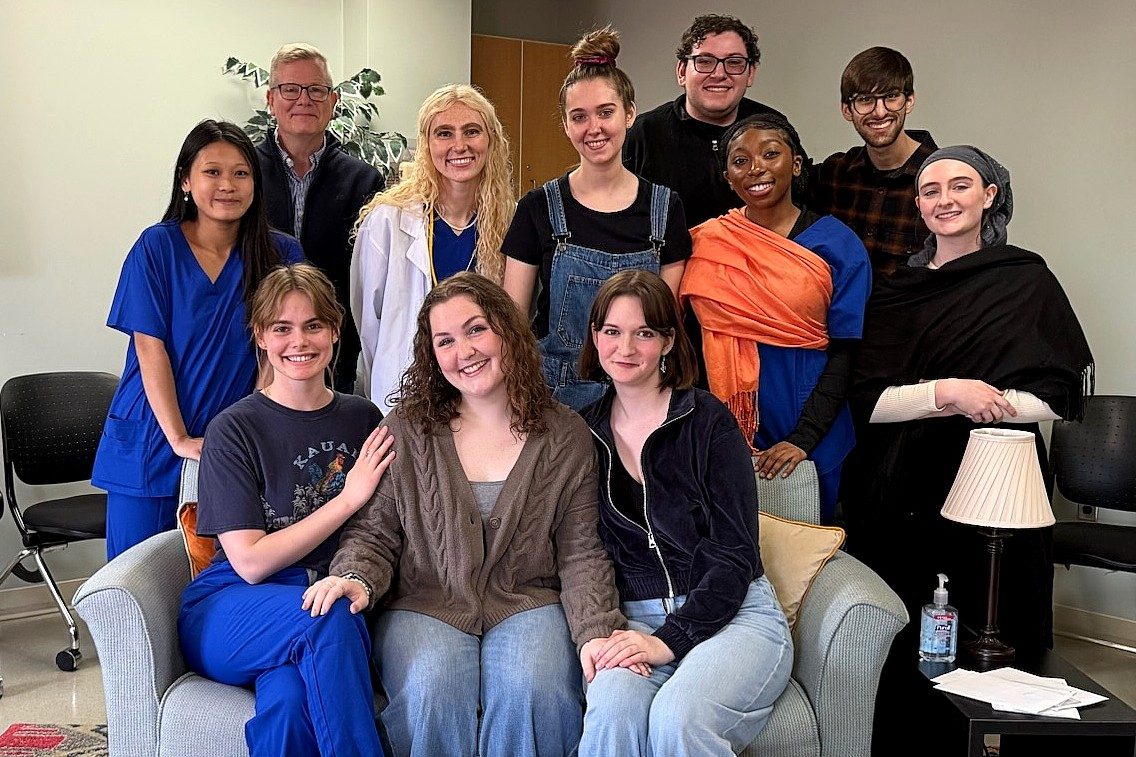
For the students involved, the production offered something far beyond a traditional stage experience — an opportunity to experiment with form, collaborate across disciplines, and invite audiences into a story in an unusually immediate way.
The production also reflects the vision behind Michigan State University’s new Arts & Humanities Health and Wellbeing initiative, which is designed to prepare students to understand health and care through both scientific knowledge and human experience. By bringing theatre into a healthcare simulation setting, “Mary Jane” demonstrates how the arts can deepen empathy, strengthen observation and communication, and help future healthcare professionals better understand the lived realities of patients, caregivers, and communities.
In this way, “Mary Jane” was more than an immersive theatre production. It offered a powerful example of how interdisciplinary learning can prepare students to approach health not only as a science, but also as a profoundly human experience.
By Kim Popiolek


