When Sally: A Solo Play, written by Michigan State University Department of English alum and acclaimed playwright Sandra Seaton, premiered at Wharton Center for Performing Arts in February, audiences witnessed a powerful reimagining of Sally Hemings – one that reclaimed the voice of a woman too often relegated to the margins of history. Now, the production will reach new audiences far beyond East Lansing as a live capture of the play produced by WKAR Public Media in cooperation with Wharton Center for Performing Arts is distributed to PBS stations nationwide.
WKAR TV 23.1 will air a special television broadcast of the play on Friday, June 19, at 9 p.m., with streaming also available on wkar.org and the free PBS app. Part of WKAR’s America 250 line-up of original programming, this world premiere television broadcast celebrates the 161st anniversary of Juneteenth, commemorating June 19, 1865 — the day enslaved African Americans in Texas learned of their freedom more than two years after the Emancipation Proclamation took effect. Additional WKAR broadcasts of Sally: A Solo Play also are planned.
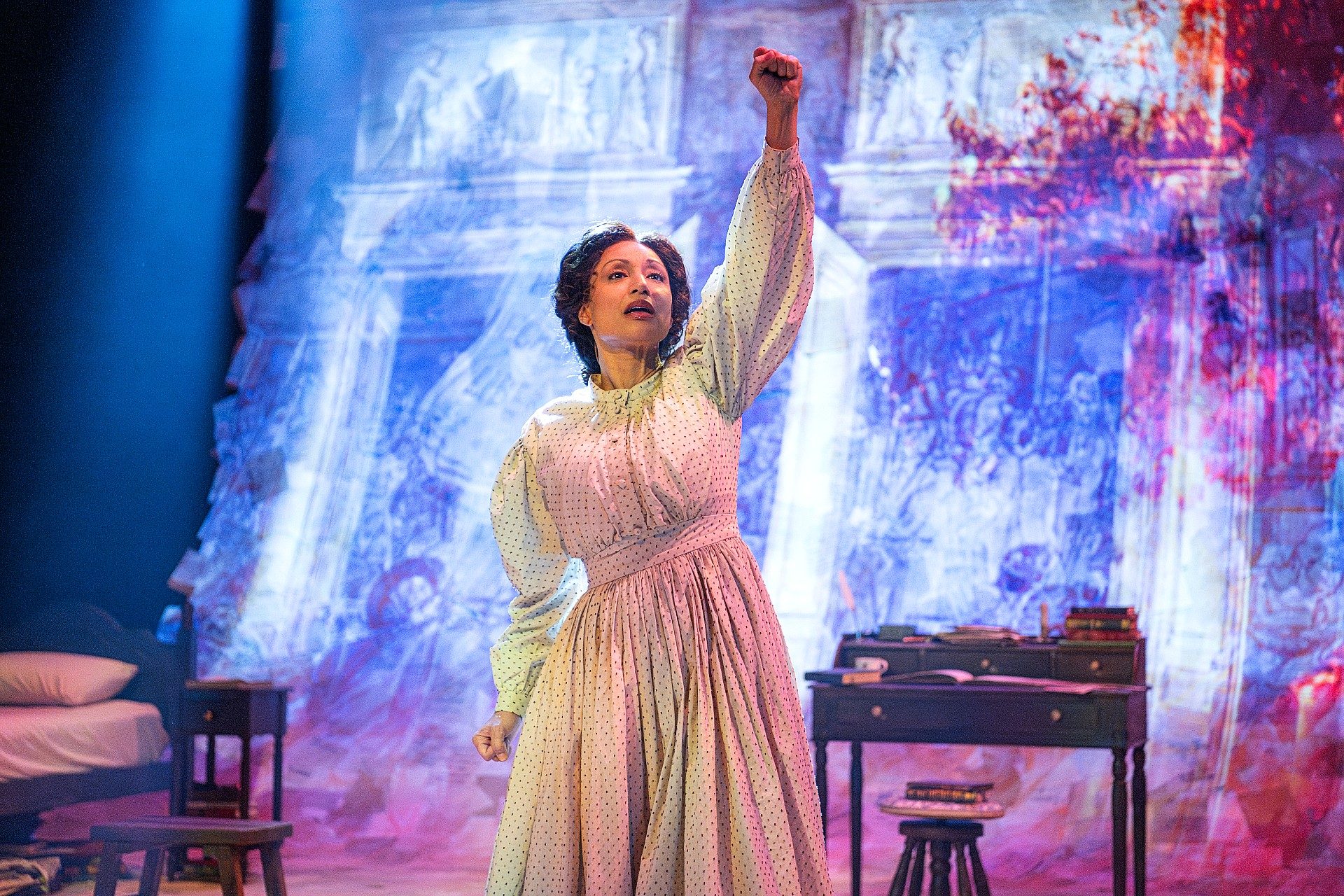


The WKAR original production is being distributed to PBS stations nationwide by American Public Television with more than 240 PBS stations across the country, including many major markets, expressing interest in airing Sally: A Solo Play. So far, 110 stations have confirmed they will air the production.
This expanded reach not only will introduce new audiences to Seaton’s nuanced portrayal of one of history’s most misunderstood figures but also showcase the work of two MSU Department of Theatre faculty members, Kirk Domer and Alison Dobbins, who were part of the production’s creative team.
“Seeing Sally: A Solo Play move from its world premiere at MSU to PBS stations across the country is a powerful reminder of how theatre can amplify important stories and connect audiences through shared history.”
Kirk Domer, Department of Theatre Interim Chairperson and Scene Designer for Sally: A Solo Play
“One of the great joys of this project has been partnering with Wharton Center and now WKAR to help bring Sandra Seaton’s extraordinary play to life,” said Domer, Professor of Scene Design and Interim Chairperson of the Department of Theatre who served as Scene Designer and created 3D renderings that served as the basis for the production’s scenery. “Seeing Sally: A Solo Play move from its world premiere at MSU to PBS stations across the country is a powerful reminder of how theatre can amplify important stories and connect audiences through shared history.”
Dobbins, Professor of Integrated Media Performance Design, served as Projection Designer, helping audiences navigate the play’s shifting emotional and temporal landscapes.

“I’m thrilled that a new audience will see Sandra’s wonderful work and this amazing performance,” Dobbins said. “I have had the good fortune to have Seaton join as a guest in my projection design classes over the past 10 years where I use Sally: A Solo Play as the text for the final project. Having the opportunity to work on the Michigan premiere performance has been a dream come true and the highlight of my career as a designer.”
The live capture recording took place during the world premiere performances, directed by Hannah Ryan, at Wharton Center’s Pasant Theatre Feb. 19-21, 2026.
“It was an honor to bring Sally: A Solo Play to life at Wharton Center…I hope that all who experience it will recognize the power of Sandra’s work and how it so clearly captures this meaningful moment in our history.”
Eric Olmscheid, Wharton Center Executive Director
“It was an honor to bring Sally: A Solo Play to life at Wharton Center earlier this year, and now to be able to share it with the public television audience,” said Eric Olmscheid, Wharton Center Executive Director. “I hope that all who experience it will recognize the power of Sandra’s work and how it so clearly captures this meaningful moment in our history.”
Sally: A Solo Play offers a deeply human portrait of Sally Hemings, reclaiming the voice of the woman whose life has long been overshadowed by her relationship with Thomas Jefferson, the third President of the United States and primary author of the Declaration of Independence.


Born into slavery, Hemings was the half-sister of Jefferson’s wife, Martha. Jefferson inherited Hemings, among many others who were enslaved, from his father-in-law and has been confirmed through DNA as the father of Hemings’ children.
Rather than centering Jefferson or sensationalizing the historical relationship, Seaton’s play places Hemings at the center of her own story and tells it from her perspective.
“My portrayal of Sally Hemings challenges the way she has been viewed in the past…I wanted her to have her own voice and for people to see this multilayered, complicated woman — not an appendage to Jefferson — but a person whose life deserves attention.”
Sandra Seaton, playwright and MSU alum
“My portrayal of Sally Hemings challenges the way she has been viewed in the past. Because she was enslaved, that has often become her only identity,” Seaton said. “I wanted her to have her own voice and for people to see this multilayered, complicated woman — not an appendage to Jefferson — but a person whose life deserves attention.”
Set at Monticello, on March 17, 1826, near the end of Jefferson’s life, the play centers on Hemings’ quest to ensure that her children will be freed from slavery at the age of 21, an earlier promise made by Jefferson.

On that March 17th, Jefferson writes a codicil to his will of March 16th, a handwritten addition that frees Madison and Eston Hemings. Sally: A Solo Play asks us to imagine what happened in those hours in between the drafts of Jefferson’s will, as the fate of Madison and Eston hangs in the balance.
For Seaton, whose career has long explored untold histories and overlooked voices, the production represents both a deeply personal and artistic milestone. The February world premiere brought the play to the stage with Broadway performer Sabrina Sloan, known for portraying Angelica Schuyler in the original cast of Hamilton, in the title role.
The production transformed Seaton’s script into an intimate theatrical experience that invited audiences to encounter Hemings not as a historical footnote, but as a fully realized person.
The transition from stage to screen marks a significant next chapter for the production.

“We are thrilled at the opportunity to partner with Wharton Center to capture the world premiere of Sally: A Solo Play,” said Ashlee Smith, WKAR Senior Director of Content and Education. “Public media is all about telling stories that deepen understanding and illuminate perspectives that have too often been overlooked. Sandra Seaton’s powerful work, combined with Sabrina Sloan’s extraordinary performance, creates an unforgettable experience that we are proud to share with audiences across Michigan and the nation as part of our America 250 programming.”
As Sally: A Solo Play expands from a world premiere at MSU to living rooms and public television stations across the country, Seaton’s work continues to invite audiences to reconsider history through the eyes of a woman finally given space to speak.
By Kim Popiolek